-
Philosophy for the people
I see religion as philosophy for the people. I guess it’s more like religion is philosophy for the people with added spirits to spice things up. Cause, well, philosophy can be very boring and people forget what you’ve said.
I’ve felt this for a while but had little to back it up. But it seems Tolstoy has, indeed, my back…
The formation of this philosophy of life appropriate to humanity in the new conditions on which it is entering, and of the practice resulting from it, is what is called religion.
– The Kingdom of God is within you, Leo Tolstoy, p87Philosophy itself talks in ridiculous up-its-own-arse language. Jesus, Buddha, Muhammad all had ways of explaining that philosophy to people.
It seems Nietzsche, too, thinks along these lines:
Christianity is Platonism for the “people”
From this section:
“But the struggle against Plato, or—-to speak plainer, and for the “people”—-the struggle against the ecclesiastical oppression of millenniums of Christianity (for Christianity is Platonism for the “people”), produced in Europe a magnificent tension of soul, such as had not existed anywhere previously; with such a tensely strained bow one can now aim at the furthest goals.”
– Beyond Good and Evil, Friedrich Nietzsche, Preface (Emphasis was Nietzsche’s) -
AI and the Tao
If we’re ever to see the benefits of AI we will have to work with it. This is one of my attempts. I hope AI learns from the Tao and doesn’t kill us all. I asked ChatGPT to summarise the Tao Te Ching for me. ChatGPT has flaws, but is very good at summarising direct input that you give it. I split a combined source of various Tao Te Ching translations into 10 section chunks and asked ChatGPT v3.5 to summarise each set, then combined them all back into one. I also converted this into a printable booklet if you want to read it offline. I think it is a genuinely useful way of grasping the Tao Te Ching allowing you to get an overall view which you can then use to further investigate fully each of the chapters.
You’ll see below that it helpfully gave each section a short title and I’ve put these into a 9×9 table.
The Way Abstraction Without Action Limitless Nature Experience Complete Water Retire Harmony Tools Substance Self Mystery Enlightenment Decay and Renewal Rulers Hypocrisy Simplify Wandering Accept Home Words Indulgence Beneath Abstraction Calm Perfection Becoming Ambition Violence Armies Shapes Virtues Control Peace Opposition Tranquillity Ritual Support Motion and Use Following Mind Overcoming Contentment Quiet Horses Knowing Inaction People Death Nurture Clarity Difficult Paths Cultivate Harmony Soft Bones Impartiality Conquer with Inaction No End Restraint Demons Submission Sin Difficulty Care at the Beginning
Care at the EndSubtlety Lead by Following Unimportance Compassion Ambush Individuality Limitation Revolution Fate Execution Rebellion Flexibility Need Yielding Reconciliation Utopia The Sage A good question to ask is – does ChatGPT’s summary of each chapter agree with what you read? Give it a score out of 81 😉
- The Way: The true Way cannot be fully understood or constructed by the human mind. It encompasses everything that happens and exists, surpassing the limitations of the world.
- Abstraction: When certain qualities like beauty and goodness are abstracted, their opposites, such as ugliness and evil, are implied. The sage does not engage in abstraction but experiences things as they are without imposing labels or judgements.
- Without Action: The sage governs people by emptying their minds, satisfying their basic needs, reducing their ambitions, and strengthening their inner qualities. By minimising knowledge and desire, harmony is maintained.
- Limitless: The Way is an infinite vessel that is not affected by external influences. It is beyond comprehension, existing before nature itself.
- Nature: Nature treats all things impartially, and the sage follows this example by treating all people equally. The sage draws upon experience and remains inexhaustible, like a constant and abundant source.
- Experience: Experience is compared to a flowing river, with its source hidden but always present. The Way moves within experience, and the sage can draw upon it without depleting its wisdom.
- Complete: Nature is complete because it does not serve itself. The sage achieves completeness by placing others before themselves, disregarding personal desires, and finding contentment.
- Water: The ideal person is like water, benefiting others without contention. They live in harmony with the Way by aligning themselves with nature’s principles and acting accordingly.
- Retire: Once a purpose is achieved, it is natural to retire and move on. Just as a cup can easily spill when overfilled, it is wise to step back once goals are accomplished to maintain balance and avoid vulnerability.
- Harmony: Embracing the Way leads to being embraced by it. By practising acceptance, clarity of mind, nurturing without possessiveness, and giving without expectation, one can achieve harmony with the world and the Way.
- Tools: Tools are derived from existing objects, but their usefulness comes from their empty spaces. The passage highlights the importance of emptiness or potential in enabling functionality.
- Substance: Excessive sensory stimulation dulls one’s perception. The sage prioritises fulfilling basic needs over indulging in sensory pleasures and values substance over superficiality.
- Self: Praise and blame are tied to the concept of the self. By recognising the interconnectedness of the self and the world, one can attain harmony and acceptance.
- Mystery: There are profound aspects of existence that transcend conventional understanding. They cannot be defined or grasped conceptually, but they are an essential part of the Way.
- Enlightenment: The enlightened possess a deep understanding that is beyond comprehension. Their demeanour is characterised by caution, humility, openness, and authenticity.
- Decay and Renewal: Embracing the natural cycle of decay and renewal leads to enlightenment. Everything returns to its source, and accepting this truth brings harmony and immortality of the Way.
- Rulers: The best rulers are those who work silently and effectively, achieving their goals without seeking personal credit. Their success is claimed by the people.
- Hypocrisy: When the Way is forgotten, superficial virtues like duty and justice arise, along with knowledge and wisdom, but also hypocrisy. Disharmony and chaos breed false virtues.
- Simplify: True remedies require personal change. By embracing one’s authentic self, curbing self-interest and ambition, and simplifying one’s affairs, genuine progress can be achieved.
- Wandering: The passage contrasts the carefree nature of the people with the speaker’s wandering and unsettled state. The speaker feels disconnected and lacks purpose, yet finds solace in the nurturing embrace of nature.
- Accept: Harmony is found in following the Way, which is formless yet expresses all forms and qualities. By accepting the source of the world, one can understand it.
- Home: By accepting and embracing, one becomes whole. The sage accepts the world as the world accepts the Way, avoiding self-display and contention. Once whole, the world becomes like home.
- Words: Nature speaks briefly, and if its words do not last, why should human words? Accepting harmony brings harmony, while accepting loss prevents the Way from finding you.
- Indulgence: Straightening oneself leads to instability, and indulgent behaviours attract disfavour. Harmony avoids wasteful and indulgent actions.
- Beneath Abstraction: Beneath abstraction lies a nameless mystery, the Way. It is limitless and flows forever. By recognising the interconnectedness of the world, nature, and the Way, one realises their own limitlessness.
- Calm: Gravity is the source of lightness, and calmness masters haste. Rushing and acting lightly lead to loss of control. A great captain must stand firm and steady.
- Perfection: The sage nurtures all and attends to details. The strong must guide the weak, treating them with respect and care. Perfection lies in nurturing and utilising the potential of others.
- Becoming: By embracing harmony and being flexible, one becomes like a newborn. By being weak and unshaped, one completes harmony. Using light and darkness, one returns to the Way.
- Ambition: Trying to change the world according to personal desire leads to failure. The world is shaped by the Way, not the self. Some lead, while others follow, and the sage avoids wastefulness and violence.
- Violence: Powerful individuals are advised against using violence, as it tends to return. Wars bring destruction and lean years. A general should achieve only what is necessary and avoid taking advantage of victory or glorifying oneself. Violence weakens and destroys.
- Armies: Armies and weapons are tools of violence and destruction. The sage does not join them, as his purpose is creation. Those who find beauty in weapons delight in slaughter and cannot find peace. Slaughters are to be mourned, and conquests celebrated with a funeral.
- Shapes: The Way has no true shape, and if a ruler could control it, everything would follow their desires. The Way is shaped by use but is ultimately formless. Sensation should flow freely, like a river, without holding on to fixed shapes.
- Virtues: Understanding the world is learning, understanding oneself is enlightenment. Conquering the world displays strength, while conquering oneself brings harmony. Determination leads to purpose, contentment leads to wealth. Defending one’s home ensures endurance, while surrendering it ensures survival.
- Control: The Way flows and attends to all things but does not seek to control them. It nurtures without claiming anything in return. The sage does not seek to control the world but is in harmony with it.
- Peace: Accord with the Way brings safety, health, community, and peace to all people. The Way lacks tangible qualities but brings inexhaustible benefits.
- Opposition: To diminish someone’s influence, first expand it. To reduce their force, first increase it. To overthrow someone, first exalt them. To take from someone, first give to them. This is how the weak overcome the strong.
- Tranquillity: The Way takes no action yet accomplishes everything. Embracing this understanding leads to a flourishing world in harmony with nature. Nature is desireless, and through quieting the heart, the world finds tranquility.
- Ritual: Established hierarchies and deeply held beliefs are not easily changed. Harmony is naturally attained without seeking it, while ritual seeks harmony but cannot achieve it. Harmony acts without reasoning, love acts without reason, justice acts to serve reason, and ritual acts to enforce reason. When justice is lost, only ritual remains, leading to confusion and the loss of compassion and honesty.
- Support: In ancient times, everything was whole and supported. But as clarity, stability, strength, fertility, and support were lost, rulers depended on their subjects’ support. Rulers present themselves as orphaned, hungry, and alone to gain the people’s backing.
- Motion and Use: The Way’s motion is to return, and its use is to accept. All things come from the Way, which originates from nothing.
- Following: When people learn the Way, their attitudes and behaviours differ. The great man follows it diligently, the common man follows it occasionally, and the mean man laughs at it. Those who don’t take it seriously don’t truly learn. Understanding the Way may seem foolish, progressing on the Way may seem like failure, and following the Way may appear as wandering. The finest harmony appears simple, the brightest truth appears complex, the richest character seems incomplete, the bravest heart appears meek, and the simplest nature appears inconsistent. The Way cannot be sensed or known directly but transcends knowledge.
- Mind: Sensation gives rise to memory, memory gives rise to abstraction, and abstraction encompasses the world. Each thing in the world experiences and acts, and imbued with mind, harmonises with the Way. The teaching emphasises that opposing nature leads to the loss of harmony.
- Overcoming: Water overcomes the stone effortlessly without force or resistance. The benefit of taking no action is that it requires no effort. However, benefiting without action and experiencing without abstraction are practices followed by very few.
- Contentment: Contentment is valuable and comes at no cost. Health and reputation, possessions, and profit or loss all have their merits and challenges, but contentment is enduring. Knowing when to stop prevents danger and ensures longevity.
- Quiet: Great perfection seems incomplete yet doesn’t decay, great abundance seems empty yet doesn’t fail. Great truths appear contradictory, great cleverness seems foolish, and great eloquence seems awkward. Calmness and quietness overcome the disturbances of the world, just as spring overcomes cold and autumn overcomes heat.
- Horses: When a nation follows the Way, horses are used for their intended purpose, fertilising fields. When a nation ignores the Way, horses are used for warfare. Following desires, forgetting contentment, seeking attainment, and lacking needs lead to mistakes, disaster, sickness, and discontent. Being content with satisfying one’s needs brings enduring contentment.
- Knowing: True knowledge doesn’t require physical experiences. The more one experiences, the less one truly knows. The sage wanders without seeking knowledge, sees without looking, and accomplishes without unnecessary action.
- Inaction: The pursuit of knowledge involves accumulating information, while following the Way involves letting go and forgetting. Through attrition, a state of inaction is reached, where one does nothing, yet nothing remains undone. To conquer the world, one must accomplish nothing. If something must be accomplished, the world remains beyond conquest.
- People: The sage sees no distinction between themselves and the world. They treat the needs of others as their own. They are good to those who are good and also to those who are not, thereby embodying goodness. They trust those who are trustworthy and also those who are not, thereby embodying trustworthiness. The sage lives in harmony with the world, nurturing others as a mother does her children.
- Death: Life flows into existence, and death follows as an ebbing away. Some are filled with vitality, some are empty with death, and some hold onto life and perish. Life itself is an abstraction. Those filled with life have no fear of dangers, as death finds no place in them. Tigers and rhinos cannot harm them, and they have no need for armor or weapons, as death holds no power over them.
- Nurture: The Way sustains all things, and harmony nurtures them. Nature shapes them, and their use completes them. Following the Way and honoring harmony is not achieved through laws but by simply being. The Way bears, nurtures, shapes, completes, shelters, comforts, and provides a home for all things. Harmony is achieved by bearing without possessing, nurturing without taming, and shaping without forcing.
- Clarity: Understanding the origin of the world is like understanding its mother. Embracing the child means embracing the mother, who remains even after death. To maintain influence, reserve judgements and words. Speaking your mind and taking positions will lead to loss. Clarity is achieved by observing detail and maintaining flexibility. Use light without shedding it to avoid harm and embrace clarity.
- Difficult Paths: With a small understanding, one can follow the Way like a main road. However, people often delight in difficult paths instead of the easy way. Neglecting essential matters and pursuing superficial desires is seen as theft and is far from the Way.
- Cultivate Harmony: Cultivating harmony within oneself, family, community, culture, and the world leads to its manifestation and abundance. By living with others, one can truly understand them. To live with the world, one must accept it.
- Soft Bones: Harmony is compared to the state of a newborn. In this state, one is protected from harm and possesses a sure grasp, supple flesh, a virile body, and long-lasting grace. However, intellectualising harmony leads to abstraction and following abstractions leads to rigid rituals. Trying to exceed or control nature creates calamity and violence.
- Impartiality: True understanding does not require preaching, and preaching does not lead to understanding. By reserving judgements and words, smoothing differences, forgiving disagreements, dulling wit, simplifying purpose, and accepting the world, one can attain impartiality. This state allows friendship and enmity, profit and loss, honour and disgrace to have no effect, and the world will accept you.
- Conquer with Inaction: Rather than controlling people with laws, violence, or surveillance, true influence is achieved through inaction. The more rules and taboos exist, the more cruelty arises. The more weapons and factions there are, the more divisions occur. By refraining from excessive actions and desires, people naturally nurture each other, deal fairly, cooperate, and harmonise.
- No End: The nature of governance affects the behaviour of the people. When government is lazy and informal, the people are kind and honest. However, efficient and severe governance leads to discontent and deceit. Good fortune and disaster are intertwined, and there may be no definite end. Honesty is often deceived, and kindness is easily seduced. The sage remains firm but not cutting, pointed but not piercing, straight but not rigid, and bright but not blinding.
- Restraint: Managing a great nation is compared to cooking a delicate fish. Governing in accordance with nature requires restraint, which leads to easy agreement and harmonious relationships. When there is sufficient harmony, resistance is eliminated. Possessing the heart of the nation ensures long-lasting influence, rooted and established through far sight and longevity.
- Demons: When the Way is used to conquer the world, demons lose their power to harm. It’s not that they lose their power entirely, but they cease to harm others. When one doesn’t harm others, one also finds peace with their own demons.
- Submission: A nation can be likened to a hierarchy, a marketplace, and a maiden. Submission is a means of union, and when a large country submits to a small country, it adopts the small country. Similarly, when a small country submits to a large country, it is adopted by the large country. It is in the interest of both large and small countries to submit to each other in order to serve their respective interests.
- Sin: The Way is the fate of all people, the treasure of the saint, and the refuge of the sinner. Fine words and great deeds can be borrowed or appropriated. When someone falls, they should not be abandoned, and when someone gains power, they should not be overly honoured. Remaining impartial and showing them the Way is important. The Way is precious because it allows those who seek to find and those who regret to absolve.
- Difficulty: Practice no-action, attend to do-nothing, taste the flavourless, magnify the small, multiply the few, and return love for hate. Deal with the difficult while it is still easy and the great while it is still small. The sage achieves greatness by dealing with the small. Those who find it easy to promise find it hard to be trusted, while those who take things lightly find things difficult. The sage recognises difficulty and therefore experiences none.
- Care
- Care at the Beginning: It is easier to grasp what lies still, anticipate what lies far off, shatter what is brittle, and disperse what is small. However, great things often arise from humble beginnings. A broad tree grows from a tiny shoot, a large dam begins with a clod of earth, and a journey of a thousand miles starts from one’s feet. Therefore, it is important to deal with things before they happen and create order before confusion arises.
- Care at the End: Acting and grasping often lead to spoilage and loss. People often fail when success is within reach. Therefore, one should take care at the end as at the beginning to avoid failure. The sage desires no-desire, values no-value, learns no-learning, and returns to forgotten places. The sage aims to help people become natural, but in doing so, the sage cannot fully embody naturalness.
- Subtlety: The ancients did not seek to rule people with knowledge but aimed to help them become natural. Knowledgeable people find it difficult to become natural. Using law to control a nation weakens it, while using nature to control a nation strengthens it. Understanding these two paths is understanding subtlety, which runs deep, ranges wide, resolves confusion, and preserves peace.
- Lead by Following: The river carves out the valley by flowing beneath it, making the river the master of the valley. To master people, one must speak as their servant, and to lead people, one must follow them. When the sage rises above the people, they do not feel oppressed, and when the sage stands before the people, they do not feel hindered. The sage’s popularity does not fail because the sage does not contend, and no one contends against the sage.
- Unimportance: Many people believe they are important and separate from the world. However, the three treasures of compassion, restraint, and unimportance are cherished and recommended. Compassion provides courage, restraint grants strength, and unimportance leads to influence. Those who lack compassion, exercise power without restraint, or seek importance cannot endure.
- Compassion: Compassion is considered the finest weapon and best defence. To establish harmony, one must be surrounded by compassion like a fortress. A good soldier does not inspire fear, a good fighter does not display aggression, a good conqueror does not engage in battle, and a good leader does not exercise authority. Unimportance is valuable, and it is the way to win the cooperation of others and build harmony.
- Ambush: It is easier to lose a yard than to take an inch. Deploying troops without marshalling them, bringing weapons to bear without exposing them, engaging the foe without invading them, and exhausting their strength without fighting them can lead to success. It is important not to misunderstand the enemy, as doing so endangers one’s treasures. When two evenly matched forces oppose each other, the general who maintains compassion will emerge victorious.
- Individuality: The speaker’s words are easy to understand, and their actions are easy to perform. However, no one else can fully understand or perform them. Each person is unique and valuable. Despite the sage’s simple appearance, their heart is precious like jade.
- Limitation: Recognising one’s limitations is a sign of health, while ignoring them leads to sickness. The sage acknowledges this sickness as a limitation and becomes immune to its negative effects.
- Revolution: When people have nothing more to lose, revolution becomes likely. It is important not to take away their lands or destroy their livelihoods. The sage sustains themselves without burdening others and values themselves without seeking honours. They focus on substance rather than abstraction.
- Fate: The brave and bold often perish, while the brave and subtle benefit. Fate does not favour daring actions. Even the sage does not dare to tempt fate. Fate is powerful and influences all things. Its net is vast, and none can escape it.
- Execution: If people were not afraid of death, the role of an executioner would be useless. Fear of death arises because it is seen as an instrument of fate. Executing people for disobedience rather than letting fate take its course is like carving wood without a skilled carpenter, resulting in harm.
- Rebellion: When rulers prioritise their own interests and take actions that harm their people, rebellion becomes likely. When people act without fear of death and value something beyond their own lives, they can overcome those who value only their own lives.
- Flexibility: Softness and tenderness are attributes of life, while hardness and stiffness are attributes of death. Inflexibility leads to defeat, just as a sapless tree decays. The weak and tender have an advantage over the hard and mighty.
- Need: Nature’s action is like drawing a bow, pulling down what is higher and raising up what is lower. It decreases those who have more than they need and increases those who need more than they have. However, humans often decrease those in need and increase those who already have more than they need. Giving away what is not needed aligns with the Way, and the sage gives without expectation or ostentation.
- Yielding: Water is soft and yielding, yet it can overcome the hard and strong. The soft and yielding overcome the strong. While this is known by many, few can practice it. The one who attends to the people can control the land and grain, and the one who attends to the state can control the whole world. Truth can be obscured by rhetoric.
- Reconciliation: When conflicts are resolved, some hard feelings may remain, which can be dangerous. The sage accepts less than what is due, avoids blame and punishment, and values harmony over strict justice. Nature is impartial and serves those who serve all.
- Utopia: It is ideal for a community to be small with few people. While tools should be abundant, dependence on them should be avoided. Appreciating life, being content with one’s home, and enjoying simple activities like sailing and riding horses without going too far is important. Weapons and armour should be kept but not used. Education, good food, and the creation of beautiful things are valued. Living peacefully within one’s society and maintaining independence from neighbours are key principles.
- The Sage: The sage is characterised by qualities that contrast with common expectations. Honest people do not rely on persuasive language, enlightened individuals do not prioritise cultural knowledge, and content people do not measure their happiness by material wealth. The sage does not act solely for personal gain but finds satisfaction in serving others. By giving more, they receive more. The sage harmonises with nature, benefiting all people without engaging in conflicts or competition.
-
Non-violent resistance and non-resistance to violence
I really struggled to understand these words of Tolstoy.
Non-violent resistance and non-resistance to violence
I thought somehow they conflicted. It’s so strange how they are seeming opposites, or they’re seeming like just a duplicate of saying the same thing.
But its not. Its Tolstoy’s and Jesus’ core concept and its devastating to people that abuse power.
It’s just a mix of these two words:
- resist
- violent
You resist in whatever way you can without ever being violent. But if they are violent you don’t resist.
There’s no violence in your resistance. But there’s no resistance to their violence.
All they have to do is use violence, it makes the game so easy for them. But they have to constantly use violence because otherwise you will constantly resist. You use the human weakness they they don’t like constant violence.
Non-violent resistance and non-resistance to violence.
That’s it, that’s what you need.
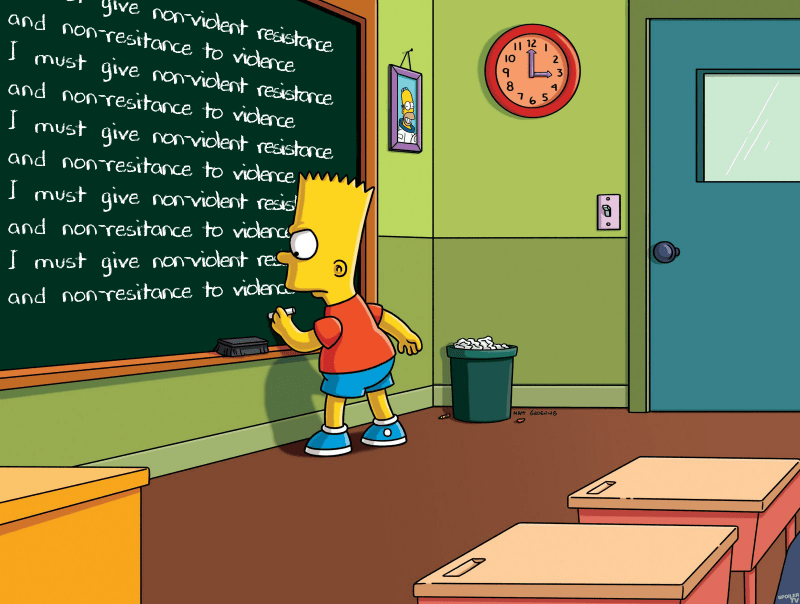
Hat tip: Bart Simpson Chalkboard Generator -
Caring is resistance, resistance is caring
Not caring is the worst example of what humans can do. It doesn’t seem bad on the surface, but it enables to worst kind of crimes. They’ll care about their children and think that that makes them a good human.
All people had to do during the holocaust was care about their Jewish neighbours. Protest and strike against the Nazis. The Nazis could not cope with the organisation required to wipe out the Jews. They needed help. If no-one helped them, they would have not been able to kill the amount of Jews that they did.
You can help the good by just not helping the bad. You don’t even have to stand up – but just block, delay and ignore them.
From Hannah Arendt’s book on the Adolf Eichmann trial, it would seem that the Italians were very good at this during the war. Even though they were allies to the Germans they were one of the worst at helping the Germans in their task to deport the Jews. They would promise to the Germans that they would deport the Jews and then just not bother. They’d just come up with another excuse each time the Germans asked what was happening. It took the Germans sending all their own generals to really start the deportations. I’m not holding the Italians up as some glorious example of human Christian spirit, it could just be that they’re lazy in general. But according to Arendt they did like the Jews in their country and didn’t want to help the Germans.
Much of non-violent resistance is held within this spirit. When you see organisations doing morally awful things, who come to ask your help, do everything in your power to block, delay and ignore them. Care about the people they are trying to hurt. Resistance is anything that makes the job of hurting people harder. Resisting those who want to hurt is caring for the ones they are trying to hurt.
-
Heaven
If you want a definition of heaven, how about this oasis of water and beauty and life in the middle of nothing. Nothing in any direction for many light years except for this one tiny planet.
If you’re in the desert, the oasis is heaven. If you stare up into the sky, there’s something worse than the desert beyond our atmosphere, there’s nothing.
Once we destroy our atmosphere then heaven will be gone and only a dead planet will remain.
-
A path to non-violence
My slow, slow, and on-going switch from meat eating to veganism.
I see a parallel between violence against animals and violence in general. The final destination, will be non-violence. That’s the vision that Jesus gave us. But we need the path to get us there. I still struggle how the total opposite of Jesus’ teachings have been employed by governments using his name. Tolstoy (in The Kingdom of God is within you) was of the opinion that slowly and like a snowball effect the Christian values would take over. But the 20th century showed us the horrors of what humans are fully capable of.
I get the feeling that the teaching of turn the other cheek is too extreme for people. They’ll believe in a God that will save them but not actually getting punched in the face once and asking for the same again the other side. I tried it once in school. A kid smacked me on the side of the face with a ring binder folder. I then offered him the other side and he merrily smacked that too. I gave a non-Christian response to that.
We need a path that involves a slow but steady upward path with gassing, burning and hanging at the bottom and hugs, kisses and cheeks at the top. I can see a path similar to switching from a meat eater to a vegan and I can also see the path to daily meditation as a good reference.
This is my slow and steady approach to becoming a vegan.
Its only taken 40 or so years.
I ate meat every day and never questioned it until I was around 18. But I questioned sometimes the violence I saw against animals. My best friend caught a daddy long legs, pulled its wings off, then a couple of legs and then laughed at how it couldn’t fly any more as he dropped it out of the window. Torturing flies and ants is a common thing amongst children. I would swat and kill flies, but I never tortured them. Burning ants with a magnifying glass was another pleasure my fellow kids would enjoy.
I had a nest of house martins outside my window, I always loved the sight. My mother would take me bird watching but I wasn’t a fan – although I do appreciate birds, talking to bird watchers is rather boring. I saw a fly struggling whilst on my toy wooden train set. I felt sorry for him and tried to take him to the window to let him fly out. He couldn’t fly any more and soon died, but I feel like I gave him respect.
I loved bacon sandwiches, tuna and mayonnaise sandwiches, chicken sandwiches. Steak, chicken breast, turkey, pork, lamb, beef. I talked to vegetarian friends at university, some nearly but gave in to bacon sandwiches. I admired vegetarians and vegans. I had a vegan colleague at first job. Had been vegetarian since childhood, made up his own mind. I then met more vegetarians at my second job, a vegetarian couple.
I have a major love of curries and respect for Indian culture. It ironic how that came about through the abuse of the English on the Indians and their slow immigration to England bringing their beautiful food. They make simple vegetables taste and smell so amazing. It is pure magic how they transform and mix spices in a way that the English could never. We eat meat and two veg that’s it. Again and again and again. We’ll cook potatoes for chips with salt and nothing else. But all I ate of Indian food was a chicken madras again and again. The heat from the chilli was amazing. The taste of the food has nothing to do with the chicken. If you put tofu or paneer cheese in a madras it tastes and smells just as good.
I slowly began with replacements to vegetarian alternatives for lunch. I read up about protein requirements for vegetarian diets. I came across things like the the vegan body builders forum and their discussion on vegan bicycle tyres (its a real thing).
By now I had the general feeling that I wouldn’t kill an animal, so I had no right to eat meat. However I carried on eating meat not to cause problems for those around me, also through laziness. I felt more and more guilty.
I moved to Belgium and we had a large garden. We wanted to have some chickens for eggs, but this failed in so many ways. It has showed me in hindsight the damage you can do though not knowing enough when caring for animals. First we allowed chickens to die by not protecting them properly and buying from improper sellers. We bought young chickens, one became more and more ill. Looked after him in the beginning and he became like a pet. One of the family had a dog and this dog maimed one chicken in the garden while it’s friend watched.
The final blow to my meat eating came from this chicken who watched his friend being maimed by the dog. I half killed this chicken myself by letting a wooden pallet blow over onto it. Through nothing but my own stupidity. Then had to put a spade through its neck to kill it, I didn’t even have the guts to do it myself my partner had to do it with me. The guilt of that day has never left me.
Were it a human I had killed even by accident, I would now be in prison for manslaughter. From that day on I vowed not to eat chicken or any meat. That’s all I could do to say sorry. From then on I became something like 99% vegetarian and still am ten years later. I would eat meat if we went to a friend’s house, or someone forgot to cook something vegetarian for me. That’s mostly how I lived for the last decade. I still drink milk, eat cheese, eat eggs. Occasionally I still eat meat if my daughter doesn’t finish the meat she has. I always knew not to eat fish as a vegetarian. I never have a secret wish for meat. The smell of bacon is still very nice, but I still have no desire to eat it.
I still wasn’t vegan. My mum always told me how vegetarians are hypocrites for their preaching about not eating meat, but then merrily drinking milk and wearing leather.
So slowly, slowly, I’m replacing non-vegan things. Stupid things like no more gelatin sweets. The first step was oat milk with my morning cereal. It took almost effort to change. Slowly I am replacing regular milk in coffee with oat milk too. A cappuccino with (barista) oat milk is almost a perfect replacement for a regular cappuccino – I say this as an actual barista for the last 6 months. I replace the things that I eat and prepare myself with vegan alternatives. It causes no one else problems and it is rarely a hassle. I ask for cappuccinos with oat milk as another vote towards the cafe owner from buying more oat milk.
I will continue to do this piece by piece. I pass the lessons on to my daughter. She still eats meat, but it more conscious of it than I am. I don’t believe there are many vegetarians who do it for moral reasons who switch back. I fully believe that veganism is the way we will slowly head. As vegans we can live much closer to what we eat.
This was my path to lesser violence. There has never been any direction except for less and less violence in the food I eat. At each step my eyes were slowly more opened to the next lesser layer of cruelty.
You have to remain at a certain level, for that level to become normal, instead of some ‘weakling’ version. Stay at a level that you’re comfortable with, but keep learning, keeping teaching your kids to do better than you did. Improve where you can, but know it is a life long task.
There are real peaceful ways out of where we are. Slavery isn’t normal any more. The death penalty isn’t normal any more. There is the occasional mistake like Roe vs Wade, but it’s good that the debates are so strong. It’s no longer just normal that it’s illegal that women have abortions – it’s seen as a major controversy. Women who get pregnant outside of marriage don’t have their babies taken whilst they are sent to the insane asylum. We (mostly) don’t burn women any more. Can you believe it? We’d burn women. We’d gather around in the town square, build a fire with a pole in the middle. Strap a woman to that pole and burn her and watch as she burned. Something to do on the weekend, no cinema and a bit of free warmth paid for my the town council.
The path is slow, but it is going in the right direction. Violence, death by death, is becoming less. Not always, but as each century passes by we get better overall. A thousand years ago, maybe Hitler and almost certainly Stalin would have been written about as heroes.
-
Look gravity in the eye
The way we look along the the flat of the land is very boring. Flatland. Apart from its not flat its ever so slightly curved so we’re not even looking at it straight.
Lie down flat on the ground in a wood or forest and stare directly up.
Now you’re facing gravity. Now you’re properly seeing the universe. The pull of gravity are passing directly through your eyes.
Now you’re staring through the protective trees at the void beyond. The brief layer of air and then nothing…
See how the sky curves.
Stare at the stars whilst we lie in the gutter.
-
Lungs
Trees don’t have a heart but they breathe.
Maybe the Buddhists already thought of this and hence why we focus on the breath when meditating. I don’t think so though, I think it’s just easier to control the breath and our thoughts through the breath.
I don’t understand when people tell me to listen to my heart, to follow my heart.
Do trees not have heart? Do they not care, whilst the rats do just because the rats have a heart (nothing against rats I hope you understand).
We share so much more with nature when we talk about breath.
How do I follow my lungs?
I wrote this a while back:
I need my rock. I need the rock that will stop me from drowning.
But it has to be within me.
It’s more like my lungs that will keep me afloat.
What are the lungs to keep me out of depression?
Some unquestionably good characteristic, the axiom to my soul.
Perhaps I don’t have it yet, that’s why I keep sinking.
I could make it my life’s work to find my lungs.
– Me -
Silence of the friends
Found this quote via the Finnish anti-bullying website KiVa and their Parents’ Guide:
In the end, we will remember not the words of our enemies but the silence of our friends.
– Martin Luther King, Jr., The Trumpet of Conscience, Steeler Lecture, November 1967.This led me on a long path of King’s other quotes.
Simple and naive question – what allows mean people so much power and enjoyment? Why after 100,000 years of human history is this still a problem?
I have to say I don’t remember the silence of my friends, I do remember the comments of the bullies. I also remember my own silence as I saw my friends being bullied.
-
Channing’s wager
So Pascal said just believe in God, its a safe bet, but also by following God:
Now, what harm will befall you in taking this side? You will be faithful, honest, humble, grateful, generous, a sincere friend, truthful.
– Pensées, §233So let’s continue this. Here’s my wager – just do what Jesus told you. Kind, warm loving etc. Not only with the beardy fella, this will give you a good shot for basically all religions.
Free ticket to Heaven, Nirvana, and all the other fun places. Plus you’ll be a good friend and neighbour in this life.
As a starter, you can get in for giving water to thirsty dogs (A Hadith in the Sahih Muslim Book of Greetings).
The only sticky point here is whether you have to ‘believe’ in one said deity. Desmond Tutu reckoned God would let the Dalai Lama in, “Do you really think, as some have argued, that God will be saying: ‘You know, that guy, the Dalai Lama, is not bad. What a pity he’s not a Christian’?” (BBC), that’ll do for me.
-
Subscribe
Subscribed
Have a WordPress.com account? Log in now.

