-
Jesus for atheists
I guess this is not much more than a review of Leo Tolstoy’s book ‘A Confession’ and his other books on religion. I’ve been an atheist as long as I felt that the words in the Lord’s Prayer were ridiculous. I believe the Bible is a work of fiction like any other book that talks of dragons and giants. I find it crazy that rational people can believe that. I find the hypocrisy of the Bishops who abused children and the cover up of the Church unforgivable – but I guess many more worse things have been done in the name of Christ. Greek and Roman Gods are seen as fake but the one dreamt up 500 years later is somehow real. If there’s only one God then only one of Christianity, Islam, Buddhism or any other religion can be right and the rest of us are damned.
I believe in Science. Lots of things can’t be explained by science yet, but science doesn’t pretend to know things it doesn’t. It remains humble it never believes you get further than a theory, even if you work your whole life on it. Science knows that what we know today is partially right but still very much wrong. Science has it’s problems and the people that abuse it, but it is explainable and doesn’t require tales of fiction to back it up. If Science is right we’re all saved from the hellish after lives, but if science is right there is no after life.
But at the same time, I’m doing like all other thinking people and searching for meaning in life. My father believed that the basic rules of Christianity were good ones to live by, but nothing more. I wonder at the cathedrals built by people looking to worship God. I wonder at the vast amount of good work that Christians do. I wonder at the happiness that my Grandmother had from just doing the flowers and helping at the church. Christians may believe in something fake but their happiness is real. Their good deeds are real. But I can’t ever join that because I know it’s fake. I can’t eat the body of Christ and believe that it’s really his body, or drink his blood and really think it’s his blood and not be put off by the rather disgusting idea of cannibalising God. I can’t bow down to an almighty nothing.
Tolstoy’s Confession is basically talking about the same. But he did much worse things in his life. He killed people in duels, killed people in war. I don’t have the direct blood of anyone on my hands. Just the blood of all the animals that have been killed for me to eat and to safely take the medicines I take. He did all that I have done but much more, he spoke to the great scientists of his day, he knew the Orthodox Church very well, read up way more than me on Buddhism and Islam. He read all that he could searching for meaning. He read all the philosophers he could all the poets, looking for something or anything with meaning.
This is the closest that I have come to someone who feels as I feel. He saw how clearly that science showed that the teachings in the Bible were fake. But his answer was the biggest crush to any hopes I had. He simply put his faith in Christianity but one that ignored all the clearly made up stories but left open the real stories and teachings of Jesus together with the existence of God. Of course the stupid thing is that in my search for the meaning of life, basically the only answer to that is religion. Religion is just all the different ways that people have tried to create meaning in life. So Tolstoy simply returned to Christianity, the Christianity of the poor where a simple, honest life gets rewarded in this life, and the next.
But this then leaves me nowhere. You get to the top of the tower searching for the answer, you open the trapdoor at the top and there’s nothing but emptiness. The meaning of life is religion and there is no religion, so there’s no meaning. Humanists and other atheists try to claim that there still is meaning, that you can lead a good life and that this one life becomes more precious. But that’s not how I feel and it’s not how Tolstoy clearly lays it out.
So this is what I understand from ‘A Confession’. Life is either finite or infinite. Scientists believe it’s finite, but God and the Universe is infinite. Religion simply matches up our finite life with an infinite afterlife. Science can never explain this like we can never count all the way to infinity. So if science is right, then us, our children, our grandchildren and all the people and animals and insects and bacteria that ever live on this planet ever are pointless. Without meaning to be forgotten. We’ve been going for 14 billion years and in 1,000 billion years everything will be gone. An infinite of nothing. That’s it there’s no way round it, there’s no hope that science will find an answer. There’s no experiment to trial, no thought experiment to see it more clearly. Newton and Einstein won’t save us. They’ll be gone and forgotten, so will we.
Tolstoy wrote that all you could do if you believed there was no God, was to either kill yourself or limp on like a coward.
But Tolstoy carries on about what his version of the real Christianity should be. He views it above all other religions because it puts love as the only rule. “Love thy neighbour” is the only commandment. Thou shalt not kill isn’t needed if you love the one you want to kill. But this is not the jealous love that we think of where a man murders his wife because he loves her too much. The love taught by Jesus is a love that conquers all. You must simply turn the other cheek if someone strikes you. The law of love comes before the law of violence. There is no space for violence, bullying, hatred, jealousy. The law of love is available to all, you don’t need money, talent, beauty, fortune, family. You just need to love those around you.
I understand this kind of Christianity. I can understand why it is so powerful. There’s nothing to laugh at when you see the power of what love can do. The impact that Gandhi managed to have through getting independence for India without resorting to war. That was love. I don’t see humanists or atheists talking about love when they talk about the meaning of life. It’s just a small part in what they believe. I also agree with how he explains that Christianity has more meaning than Paganism because it puts love as the one and only law.
The only trouble I had with Tolstoy’s discussions about religion was the conflict between “non-resistance to violence” and “non-violent resistance”. You can’t resist if you believe in non-resistance. But I’m happy to live with that conflict. I’d see it as never using violence to resist, but if someone is violent to you then you don’t resist them. But you can resist them as long as they don’t turn to violence.
This love at the centre of Christianity is something that I’ve never heard before. “Thou shalt not kill” comes up, “forgive us our trespasses” and so forth. Jesus talks about love, but I’ve never heard it expressed that love is the only thing that matters. But what I see is that this line of thinking is open to all. You can be an atheist but follow the guidance of Jesus and put love above all else. You can love your family more, love your partner more, love your children more. Forgive them for when they are angry, apologise for the things you say and do. You can love your fellow neighbour and check how they are doing and what you can do for them.
I’m not saying I do these things, but I see it as perfectly valid that an atheist can follow the teachings of Jesus where he speaks about love. There is no church required. There is no afterlife required. But if you do choose to dedicate your life to loving others it will be a happy one. You can believe in science, think God is a fraud, limp cowardly forward without meaning, but still find happiness with Jesus and Love.
-
What if the trees were the real angels?
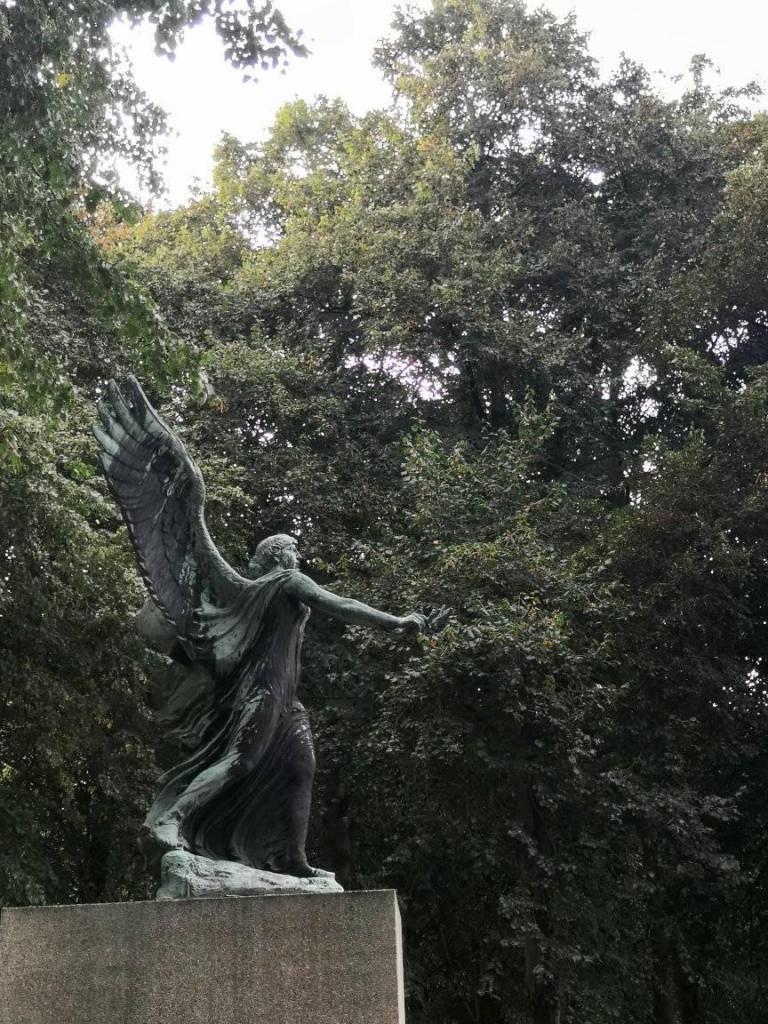
“What if the trees were the real angels?”
— Me, Lier, 2021This is what I sat to think looking at this war memorial angel statue in Lier.
Turns out there is a name for this – Pantheism.
My interpretation is roughly that Nature and God are the same thing.
This makes sense to me because it’s reasonable to me to say:
“
GodNature created us”. -
Fumblings about compassion
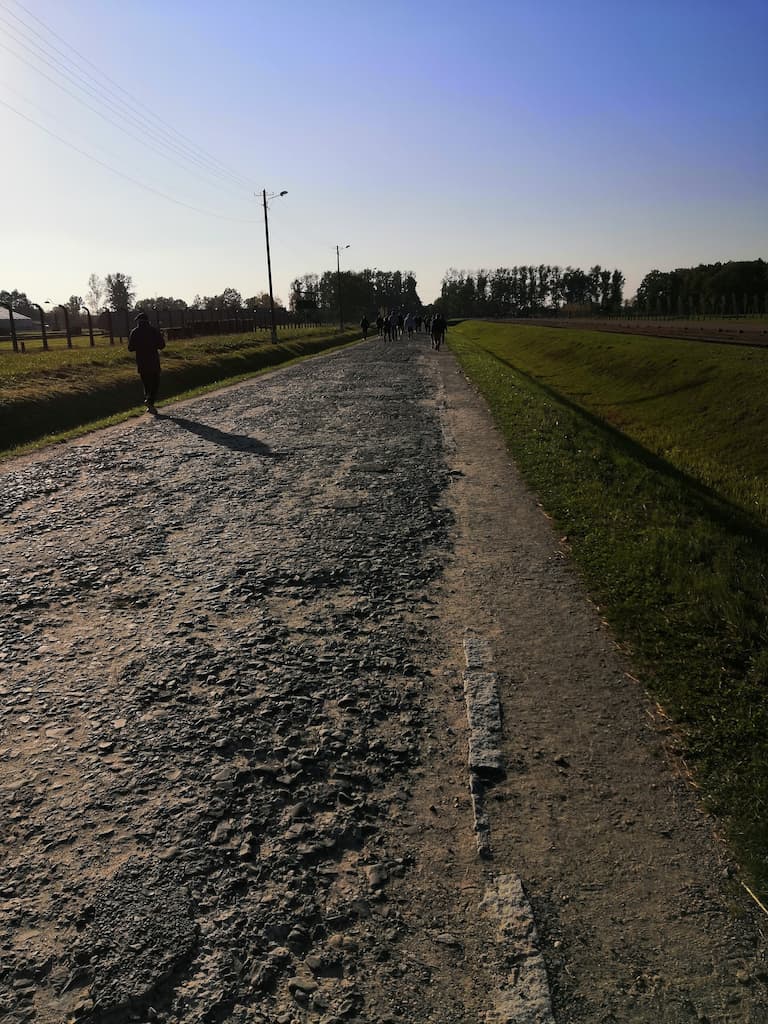
“One with compassion is kind even when angry
one without compassion will kill as he smiles.”
Shabkar – Tibetan poetI went to Krakow, Auschwitz I and Auschwitz II – Birkenau. It was surprising how un-horrifying it was. Birkenau was certainly bleak but its very hard to picture in my my mind the terror of the victims, even as you walk along the same path they do to the gas chamber.
What stuck in my mind was the Nazi doctors and in particular Josef Mengele who would smile and whistle whilst they went about selecting people for the gas chamber. This was not to make me think about I hate them, but to view them as humans who had no compassion at all towards the Jews and the other victims in the camp.
Rather than look at whether people are good or bad, I think that we can look at humans along a spectrum of how much compassion they show. Even this gets harder to judge because Hitler was a supporter of animal welfare (assuming it wasn’t all Nazi propaganda) and was very fond of dogs, so he certainly had compassion but none for the Jews. So compassion alone is not enough, selective compassion can be just as bad.
Perhaps a better way to look at it is having compassion for things we hate or don’t care for. This becomes a clearer way of separating ourselves and our future selves from those who try to kill under the idea of some ‘just’ cause.
Taking this as far as I can imagine matches the Buddhist criteria for having compassion for all things that can suffer. To prevent the future horrors of another version of the Nazis, our compassion has to include all humans whatever they have done. Whatever our feelings are for others we must have compassion for them.
This is where I see a difference between the Christian “Love thy neighbour” against the Buddhist “remove suffering for all that can suffer”. Love is more powerful than compassion and I appreciate that part of Christianity more and more. But I want to prevent future wars and “Love thy neighbour” is too open to cynicism and misinterpretation. Christianity is too often twisted to fuel wars. Buddhism appears to be a more humble attempt to get people to change the way they think.
So I see space for having a Buddhist focus of compassion for all living creatures (or all that can suffer) and then keep moving towards the Christian ideal of love.
-
Philosophy for the love of it
I’m going to post my thoughts here. “Shitty philosophy” seems like the best description of what I do. I’m an amateur philosopher, in the sense that I do it for the love of it. I search for the border between religion and science.
I also swear lots, so might as well get you prepared for it.

-
Subscribe
Subscribed
Have a WordPress.com account? Log in now.

