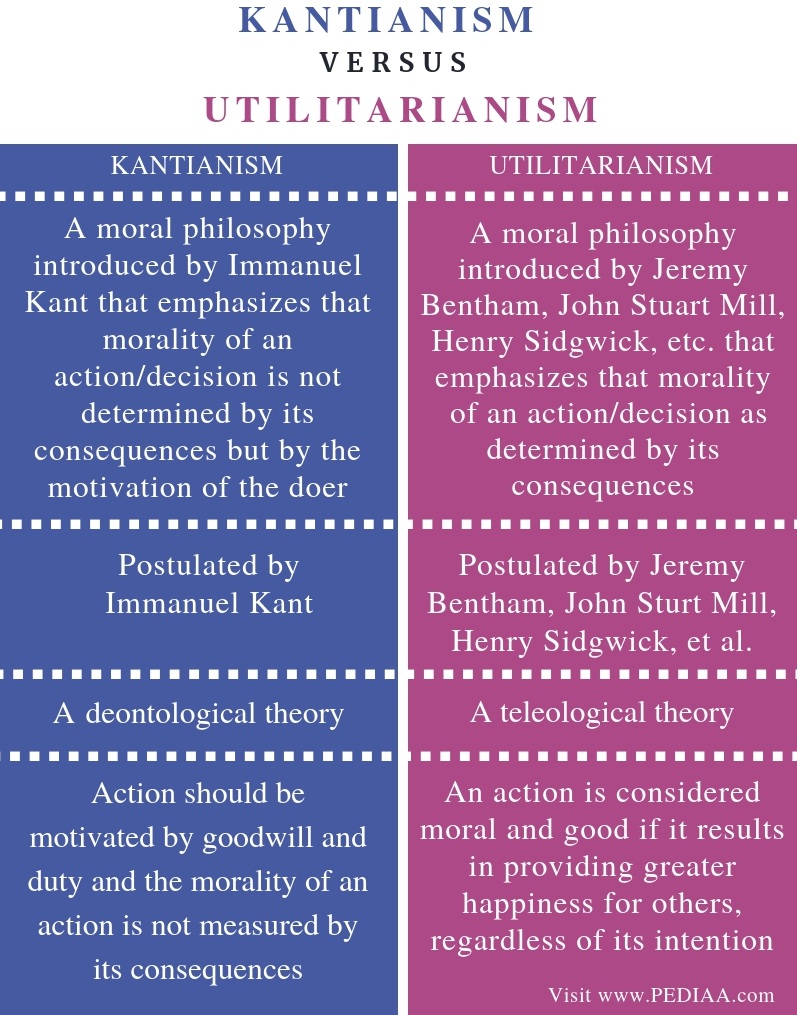
-
Utility
I’ve always struggled to agree with economics. I have a masters in economics, but the more I studied it, the less impressed I became. Utility seems like such a weasel word.
I found this table on the interwebs when trying to clarify in my mind about utility:
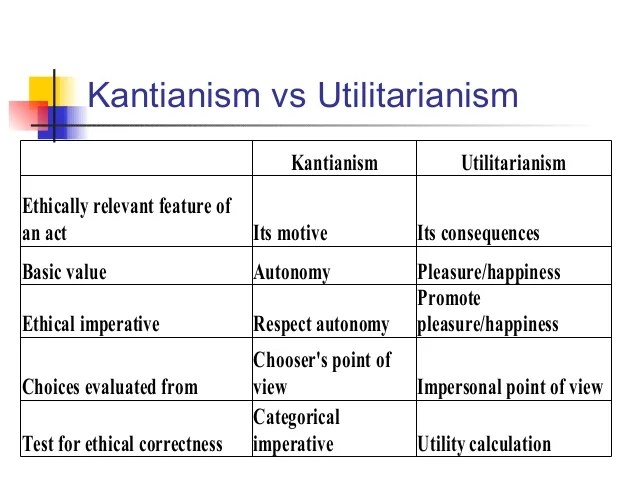
Source: slideshare.net I hate the terms ‘Kantianism’ and ‘Utilitarianism’, we don’t talk about Christianism. I’m just about ok with Christian because it’s such a well know part of our vocabulary maybe even Judaism, but just sticking ‘ianism’ on everything just creates a language for Philosophers and Economists only.
Lets keep it short and more personal, Kant vs Utility (Bentham & Mill).
Here’s a cleared up, less powerpoint-y, table for you:
Kant Utility (Bentham & Mill) Ethically relevant feature of an act Its motive Its consequences Basic value Autonomy Pleasure/happiness Ethical imperative Respect autonomy Promote pleasure/happiness Choices evaluated from Chooser’s point of view Impersonal point of view Test for ethical correctness Categorical imperative Utility calculation The utility calculation makes Utilitarianism bullshit. You can’t have a calculation for ethical correctness. There’s no maths involved.
I guess they want to know how to judge which is the more ethical between two choices. You can have a rough sense of which is probably better, but there are no proofs.
I can’t be justified in torturing my victims with a p-value of 0.96. Somehow economics thinks you can. You can’t math your way out of the gutter.
You can mess around the edges with money – but that’s it. Economics can help take money off the table as a problem so the rest of us can get on with our lives. But economics should have nothing to say beyond money. Keep your hawks and doves.
I’m definitely on the side of Kant.
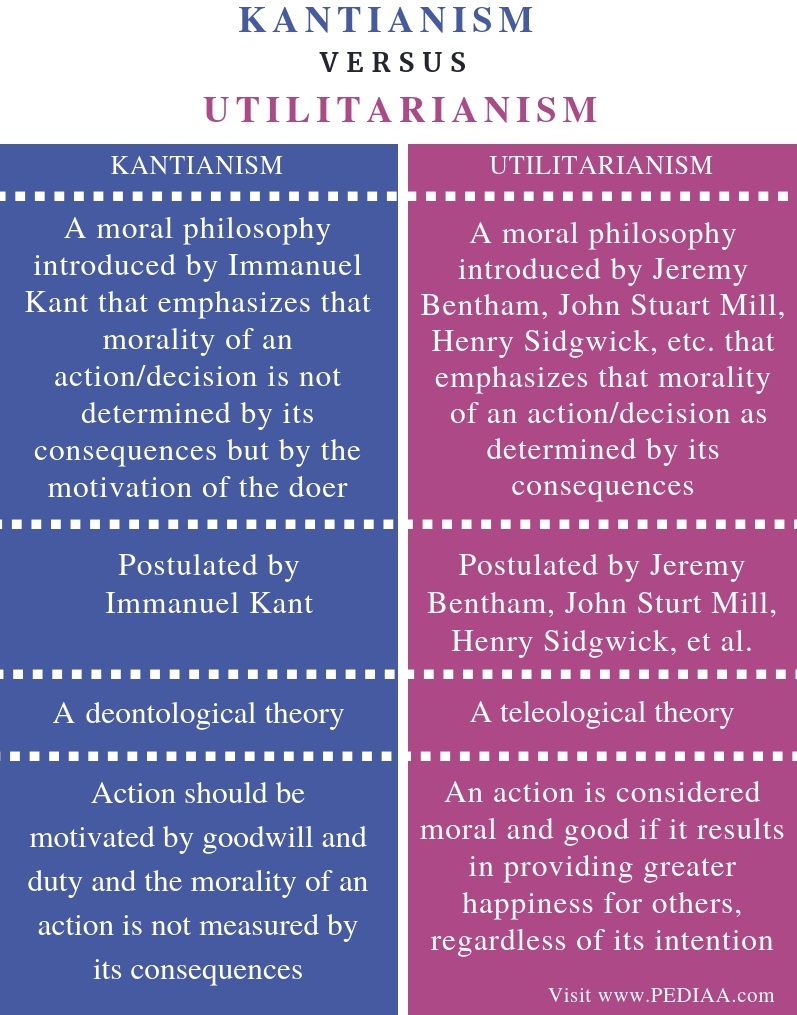
Source: pediaa.com Again here hopefully is a clearer table:
Kant Utility (Bentham & Mill) Morality of an action/decision is determined by the motivation of the doer Morality of an action/decision is determined by its consequences Deontology theory – goodwill/duty/rules Teleology theory – finality Utility boils down to:
“The ends justify the means”.
Kant likes people, Bentham & Mill like results.
Good people getting bad results:
- Kant says good
- Utility says bad
Bad people getting good results:
- Kant says bad
- Utility says good
Utility doesn’t like good people who mess up – hellooooo Jesus (his intention was good, but there were lots of bad consequences of Christianity). Utility likes bad people doing good things for selfish reasons – hellooooo capitalism.
Bad people doing good stuff does not make them/it good. They’re playing you. Perhaps there’s short-term gains, but its going to end badly.
Capitalism I guess accepts people are bad and tries to get what it can out of them. Maybe I can see like a tactical short term use for utility. It’s better than a worst case scenario – utility assumes everyone is terrible and needs some way to get along.
The butcher hates the baker but needs bread for his steak sandwich.I can also see similarities to Islam (Utility) against Christianity (Kant). Islam accepts there will be fighting, so gives rules for warfare. Christianity rejects violence of all kinds which is great in the long term, but allows people to do whatever they want in the mean time whilst claiming that they’re still Christian.
Jesus agrees with Kant. Miyazaki the director of the Studio Ghibli film Princess Mononoke agrees with Kant – bad results doesn’t mean bad guys. The steel town in the film, there are good people there, but they still destroy their surroundings. Utility would call them bad people.
The problem for Kant is measuring motive/goodwill is hard – non-profit isn’t always better than profit. You should focus on the actions and motivation – what they did in the moment, then practice to improve the action. Luck is always in the result. There is no luck in actions. NASA do this. After each mission they consider how much luck played into the success of the mission.
Utility likes to bask in the glory of luck. Do you feel lucky?
-
Steelmanning the strawman – John Stuart Mill
Lean on me
— Lean on me, Carter USM
I won’t fall over
I’m made of steel
And stone cold soberI discovered On Liberty (free to read via gutenberg.org) from John Stuart Mill , whilst reading about steelmanning.
He who knows only his own side of the case knows little of that.
— On Liberty, John Stuart MillI love the idea of steelmanning because it helps to clear up what people mean by strawmanning. I heard the term strawman a lot, probably more than any other in online discussions, but didn’t understand it. Strawman just made me think of The Wicker Man.
The term ‘strawman’ on it’s own is very ambiguous, is it that it’s flammable or a voodoo doll? Of course now I know, the focus of the straw is that it is weak, same as in straw house vs brick house for the three little pigs. Steelmanning however, even on it’s own, seems much clearer as to what it means, there is no ‘steelman’ doll. Perhaps ‘feathermanning’ would be clearer than strawmanning. Or even ‘strawhousing’ – I’d understand the reference to the three little pigs then. I think effectively this is what you do with strawmanning – you build your oppositions argument in such a way that you can blow it down easily.
So hopefully you’ll be able to more creatively straw… err… steelman people now 😉 The point of steelmanning is not to win the argument, its to better inform yourself.
I’ve bolded the relevant bits below, but I want to include the whole piece for context.
“If the intellect and judgment of mankind ought to be cultivated, a thing which Protestants at least do not deny, on what can these faculties be more appropriately exercised by any one, than on the things which concern him so much that it is considered necessary for him to hold opinions on[Pg 66] them? If the cultivation of the understanding consists in one thing more than in another, it is surely in learning the grounds of one’s own opinions. Whatever people believe, on subjects on which it is of the first importance to believe rightly, they ought to be able to defend against at least the common objections. But, some one may say, “Let them be taught the grounds of their opinions. It does not follow that opinions must be merely parroted because they are never heard controverted. Persons who learn geometry do not simply commit the theorems to memory, but understand and learn likewise the demonstrations; and it would be absurd to say that they remain ignorant of the grounds of geometrical truths, because they never hear any one deny, and attempt to disprove them.” Undoubtedly: and such teaching suffices on a subject like mathematics, where there is nothing at all to be said on the wrong side of the question. The peculiarity of the evidence of mathematical truths is, that all the argument is on one side. There are no objections, and no answers to objections. But on every subject on which difference of opinion is possible, the truth depends on a balance to be struck between two sets of conflicting reasons. Even in natural philosophy, there is always some[Pg 67] other explanation possible of the same facts; some geocentric theory instead of heliocentric, some phlogiston instead of oxygen; and it has to be shown why that other theory cannot be the true one: and until this is shown, and until we know how it is shown, we do not understand the grounds of our opinion. But when we turn to subjects infinitely more complicated, to morals, religion, politics, social relations, and the business of life, three-fourths of the arguments for every disputed opinion consist in dispelling the appearances which favour some opinion different from it. The greatest orator, save one, of antiquity, has left it on record that he always studied his adversary’s case with as great, if not with still greater, intensity than even his own. What Cicero practised as the means of forensic success, requires to be imitated by all who study any subject in order to arrive at the truth. He who knows only his own side of the case, knows little of that. His reasons may be good, and no one may have been able to refute them. But if he is equally unable to refute the reasons on the opposite side; if he does not so much as know what they are, he has no ground for preferring either opinion. The rational position for him would be suspension of judgment, and unless he contents himself with that, he is either[Pg 68] led by authority, or adopts, like the generality of the world, the side to which he feels most inclination. Nor is it enough that he should hear the arguments of adversaries from his own teachers, presented as they state them, and accompanied by what they offer as refutations. That is not the way to do justice to the arguments, or bring them into real contact with his own mind. He must be able to hear them from persons who actually believe them; who defend them in earnest, and do their very utmost for them. He must know them in their most plausible and persuasive form; he must feel the whole force of the difficulty which the true view of the subject has to encounter and dispose of; else he will never really possess himself of the portion of truth which meets and removes that difficulty. Ninety-nine in a hundred of what are called educated men are in this condition; even of those who can argue fluently for their opinions. Their conclusion may be true, but it might be false for anything they know: they have never thrown themselves into the mental position of those who think differently from them, and considered what such persons may have to say; and consequently they do not, in any proper sense of the word, know the doctrine which they themselves profess. They do[Pg 69] not know those parts of it which explain and justify the remainder; the considerations which show that a fact which seemingly conflicts with another is reconcilable with it, or that, of two apparently strong reasons, one and not the other ought to be preferred. All that part of the truth which turns the scale, and decides the judgment of a completely informed mind, they are strangers to; nor is it ever really known, but to those who have attended equally and impartially to both sides, and endeavoured to see the reasons of both in the strongest light. So essential is this discipline to a real understanding of moral and human subjects, that if opponents of all important truths do not exist, it is indispensable to imagine them, and supply them with the strongest arguments which the most skilful devil’s advocate can conjure up.”
— On Liberty, p66-69, John Stuart Mill -
The Kingdom of Delusion is Within You
I’ve been reading Tolstoy’s The Kingdom of God is Within You alongside Dawkins’ The God Delusion.
I agree with almost all that Dawkins has to say, yet in my eyes he says it without any of the grace or weight or feeling of Tolstoy.
They’re both attacking the church, but Dawkins chooses to attack all believers of God.
He finds the weakest points of Christianity and the Bible and attacks relentlessly.
I understand his frustration, I want to vent in the same way against the church.
But I take very little inspiration from his book. He’s written out concisely all the stupid shit that the Bible is full of.
But it leaves me feeling empty.
I genuinely believe that if we follow the path of Dawkins where we ridicule everything Jesus stood for and remain guided by nothing but science we will destroy our planet before we can stop ourselves.
Tolstoy is trying to explain to us the good that is in the teachings of Jesus.
We need the teachings of Jesus to help us guide science. Science is something created by humans not by nature. Nature balances everything perfectly to live in harmony. Science is great and it’s the greatest tool we have, but science really doesn’t give a fuck about you or me. I guess nature doesn’t care either…
We need the words of Jesus and Tolstoy. The law of love over the law of violence. Science has nothing to say on this. It can count the number of bodies for you and help rack up the number of bodies faster. Science can keep you happily distracted staring through your telescopes and microscopes, figuring out the puzzles there. In the mean time, the humans that don’t give a shit about nature go about using whatever they can to destroy whatever they want.
I do hope Dawkins’ book will open the eyes of the delusional. The Old Testament is a farce and most of the New Testament too.
Science won’t save us. The earth doesn’t need saving, the earth needs us to stop fucking about with the new powerful tools. Jesus and Tolstoy, on the other hand, if we listen really really carefully, might save us.
Until we stop the violence against all of nature’s creatures (including ourselves) we’re going to turn our paradise of earth into hell on earth. -
UK priests sent people to burn
The priests and bishops in the UK sent people to burn, the highest priest in the land, the Archbishop of Canterbury very willingly went first.
These new powers allowed the bishops to arrest and imprison all preachers of heresy, all schoolmasters infected with heresy, and all owners and writers of heretical books. On refusal to abjure (solemnly renounce) or relapse after abjuration, the heretic could be handed over to civil officers, to be taken to a high place before the people and there be burnt, so that their punishment might strike fear in the hearts and minds of others. In April, 1399, William Sawyer was convicted of heresy and put to penance by his bishop. He was again arrested on 12 February 1400, as a relapsed heretic and was convicted by the Archbishop of Canterbury. Sawyer was burnt on 2 March, eight days before the power to inflict such punishment was granted. There is a long list of those burnt, or hanged and burnt, between 1414 and 1506.
– Blasphemy ecclesiastical offences, WikipediaThe Archbishop of Canterbury sentenced a man to burn to death 8 days before a law was brought in to do that in 1400. Apparently, so long as the law allows it, burning a heretic is a Christian thing to do. Its the thing that the highest Christian in England would wish to do. This is 1400 years after Christ was born. Try to think of a time in 1400 years, in the year 3400. Star Trek is 2200 – 2400. Do you think we will have figured out that burning people is wrong by then? Would it have been more Christian if the Archbishop had just sent him to a gas chamber (had it been available) and burnt the body afterwords? Do we think that the Archbishop of Canterbury went to heaven?
Burning people is not compatible with Christianity, you don’t need to be a Christian to know that. If the head of your Christian church does things that don’t comply with the faith he claims to preach then your church has failed. The church should willingly disband itself. If the head of your church burns people 1000 years after the religion arrived, they clearly have not learnt what Christianity is, nor can they ever. If the church truly were run by Christians they would know this.
From this I conclude that the Church of England is not run by Christians. This is just one example. This alone should be enough to prevent anyone who fully reads the teachings of Christ from attending a church. If you want to be Christian, love thy neighbour, help the poor and don’t burn people. You don’t need a church. Everything that is done in current day countries that still send people to death for heresy and blasphemy is no different to our own countries. It’s not the faith that’s the problem, its the people in power abusing the faith.
Richard Dawkins argues in ‘The God Delusion’ that religion gives those in power an easy way to justify their killing. But I disagree that that is the main problem. Stalin and Mao had no need for religion to do what they did, dictators will use what ever is the easiest tool to carry out their job. They don’t need religion but if it’s around they’ll use it. Getting people to rely on ‘faith’ and belief in a magical God will make people more gullible and that part of religion I agree should be looked at critically. I fully support secularism and religion should not have a part of the state, but dictators find a way even if there is no religion. For control they need intimidation, corruption and hypnotism (The Kingdom of God is Within You, Tolstoy), if they don’t have religion for hypnotism they use patriotism instead. The teachings of Jesus were explicitly set out to avoid the creation of future dictators. Not having religion won’t stop dictators, but the teachings of Jesus are designed to stop them. Religion isn’t perfect, its mixed up with spirituality and faith, but also amongst the dirt there are the words the provide the solution to dictators. Even if the words Jesus spoke get twisted and abused, its up to us to understand the teachings of non-violence and love and slowly weaken the power of violence that dictators want to use.
-
Paradise
Background
Reading about Creed because of a future post I want to write about the Nicene creed vs Sermon on the mount led me to the Islamic ‘tie’ Aqidah (as close as it gets to creed).
thus the Islamic concept of ʿaqīdah (literally “bond, tie”) is often rendered as “creed”.
— Creed, WikipediaThen with in Aqidah, there are the six articles:
- Belief in God and tawhid (monotheism)
- Belief in the angels
- Belief in the Islamic holy book[11]
- Belief in the prophets and messengers
- Belief in the Last Judgment and Resurrection
- Belief in predestination
Then the Hadith of Gabriel ‘The first and most holy aqida’. This contains the 5 pillars of Islam and then also sometimes Jihad and Dawah.
It then moves on to Eschatology which I guess is talking about the ‘Last Judgement and Resurrection’.
The places for the believers in the hereafter are known as Paradise and for the non-believers as Hell.
This led me to Islam referring to ‘Paradise’, I guess I’ve known about this, the 70 odd virgins, but I always had it in my head as there being 70 virgins in heaven. The Islamic God is the same as the Christian God, but they disagree about the prophets on earth, so I always pictured heaven for the Islamic after life.
The good stuff
Now I’ve never thought of paradise as a holy place. Heaven is the high and holy place, paradise is something on earth. Paradise is nice and all, but is missing angels and stuff. Paradise is a very interesting concept because heaven was only talked about by the Christians, paradise is talked about by every faith.
The word “paradise” entered English from the French paradis, inherited from the Latin paradisus, from Greek parádeisos (παράδεισος), from an Old Iranian form, from Proto-Iranian*parādaiĵah- “walled enclosure”, whence Old Persian 𐎱𐎼𐎭𐎹𐎭𐎠𐎶 p-r-d-y-d-a-m /paridaidam/, Avestan 𐬞𐬀𐬌𐬭𐬌⸱𐬛𐬀𐬉𐬰𐬀 pairi-daêza-. The literal meaning of this Eastern Old Iranian language word is “walled (enclosure)”, from pairi- ‘around’ (cognate with Greek περί, English peri- of identical meaning) and -diz “to make, form (a wall), build” (cognate with Greek τεῖχος ‘wall’). The word’s etymology is ultimately derived from a PIE root *dheigʷ “to stick and set up (a wall)”, and *per “around”.
By the 6th/5th century BCE, the Old Iranian word had been borrowed into Assyrian pardesu “domain”. It subsequently came to indicate the expansive walled gardens of the First Persian Empire, and was subsequently borrowed into Greek as παράδεισος parádeisos “park for animals” in the Anabasis of the early 4th century BCE Athenian Xenophon, Aramaic as pardaysa “royal park”, and Hebrew as פַּרְדֵּס pardes, “orchard” (appearing thrice in the Tanakh; in the Song of Solomon (Song of Songs 4:13), Ecclesiastes (Ecclesiastes 2:5) and Nehemiah (Nehemiah 2:8)). In the Septuagint (3rd–1st centuries BCE), Greek παράδεισος parádeisos was used to translate both Hebrew פרדס pardes and Hebrew גן gan, “garden” (e.g. (Genesis 2:8, Ezekiel 28:13): it is from this usage that the use of “paradise” to refer to the Garden of Eden derives. The same usage also appears in Arabic and in the Quran as firdaws فردوس.
The idea of a walled enclosure was not preserved in most Iranian usage, and generally came to refer to a plantation or other cultivated area, not necessarily walled. For example, the Old Iranian word survives as Pardis in New Persian as well as its derivative pālīz (or “jālīz”), which denotes a vegetable patch.
— Paradise, WikipediaSlight digression… amongst the above section I spotted this:
pardes, “orchard” (appearing thrice in the Tanakh; in the Song of Solomon (Song of Songs 4:13), Ecclesiastes (Ecclesiastes 2:5)
Richard Dawkins in ‘The God Delusion’ 2006, p383 referred to the ‘Song of Songs’ and Ecclesiastes as one of the parts of the Bible that he thinks has outstanding literary merit. I’m sure that’s not relevant, but interesting connection nevertheless.
What I’m interested in is these related terms:
- A walled enclosure
- Walled gardens
- Royal park (Aramaic)
- Orchard
- Garden (hence Garden of Eden)
- Plantation / cultivated area
- Vegetable patch
Heaven (paradise) isn’t in the fucking sky, it’s in your garden. Those fairies singing at the bottom of the garden are the bloody angels.
Jesus didn’t float off into the sky, he went round the back, sat in his garden and munched an apple. Maybe he made some cider with the leftover apples.
Afterthought: Hmmm… paradise… plantations, vegetable patches, gardens… agriculture. So maybe because agriculture gave us our way of life we believed it was our paradise. But clearly according to these translations paradise is not in the woods. This damages my theory of the trees being the angels and the forest being paradise.
-
We’re in Hell (it’s just not that bad yet)
I keep thinking how we create hells on earth (torture, slavery, colonialism, war, pollution, sweatshops, factories, sacrifice, genocide, gas chambers, executions, mafia, gangs, poisons, concentration camps, suicide, terrorism, horror films, gladiators, nuclear bombs). Maybe this was Jesus’ point – if we don’t follow his advice hell is where we will end up. The more you use violence the worse it gets. So the only way to stop us all going to hell is not to use violence at all. You have to get out of the vicious circle. However what he didn’t make clear is, where hell was. I propose we’ll create hell for ourselves, we won’t get sent there, we’ll bring hell to us.
We never create paradise, there are places that seem like paradise, but the earth created them, not us. We tear down paradise and put up parking lots. We go to places of paradise (America, Africa, India and Australia), kill their children, steal their workers, their gold and everything of value. Then use everything we take to butcher each other and our children in new and inventive ways.
The only bit we missed in the trip to hell is that there was no judgement day. It turns out it would be too easy if there was a warning saying ‘Judgement Day next Friday’. There was no final warning, just a billions of small voices shouting from inside each our consciences. Jesus the sneaky bastard could have explained that better. Maybe he did in Aramaic and it just got lost in translation. Or maybe judgement day is the day you die. The judgement currently is you die knowing that the world is in pain, that you’ve lived from other’s suffering.
You don’t go to hell when you die, its much worse, you send your kids and your grandkids to hell. You create the hell for them to be born into. The abuse of the poor still continues, just not in our own countries. The abuse of animals still continues in our very own countries. Until this violence, against all that nature creates, stops we will keep turning our paradise into hell. Following this reasoning, things can get much much worse. We haven’t stopped the violence. We still carry it on. What we have remaining of paradise is going to be turned into hell. What could be worse about hell than knowing that you created it? That you took heaven and destroyed it. That is mental torture for you and all your genetic future generations. We may think we have only one life, but our genes live on, so the torment remains.
Tolstoy said the same as Jesus, so much of what he speaks about in The Kingdom of God is Within You came true after he died. We didn’t listen to his warnings. Maybe Tolstoy was the second coming, once he died and we ignored everything he had to say we ended up exactly where he said we would, butchering each other again and again, then raising butchers among the butchery to carry it on for the generations to follow. Judgement day arrived the day Tolstoy died. Maybe we’ll have to wait another 2000 years (give or take a century or two) until the next one shows up.
Maybe suicide too is our own personal hell. Animals almost never commit suicide in the wild except to protect their family – which I don’t view as suicide, I mean suicide that isn’t self-sacrifice or martyrdom. I mean the suicide when this place has become so like hell to you that you’d rather just leave now than wait around to see it getting worse. Nature is merciful, but ruthless. You can get out of hell if you just kill yourself. The angel of mercy that puts you out of your misery. Once you die the pain will stop. However you’ll die knowing you left hell behind for the ones you love.
Beyond that God isn’t human, but Satan is. Further, there isn’t one Satan, there’s many Satans and many more waiting to come. If you think Hitler and Stalin were the last ones, the other Satans are here, just waiting for their opportunity. The greatest trick the devil ever pulled was to convince people he didn’t exist. He exists alright. Our punishment is knowing that we allowed him to come and take over. We carried on our wars and created weapons ready for when he comes. God doesn’t want our weapons, trees and birds aren’t interested in our weapons, but Donald and Vladimir or their future replacements sure are. Maybe even scarier it could be any of us. Inside each and everyone of us is a brain that is capable of creating the next layer of hell. You don’t need a lot of intelligence to lead a nation (George W. Bush taught us that), just some messed up belief that what you’re doing is right. Satan believes he’s the good guy. It’s that fucker nature that keeps getting in the way. Once we’ve destroyed nature once and for all we truly will have created hell on earth. The final hell looks a lot like Mars – a red and dead planet.
Indeed maybe that’s what the Fermi paradox is about. Genes are selfish and the sad by-product is that they don’t know how to stop once they’ve conquered the planet they’re on. They just carry on wanting to reproduce at the expense of everything else. The cancer or the virus that kills the host. So on every planet where life occurs the genes kill themselves off before getting off of the planet.
But if we want paradise, we just have to realise its already here. Nature, the living world around us, that’s paradise, that’s heaven. Err… Heaven really is a place on Earth.
-
The Measure of Population Control
(Edit: This was initially titled The Three Dimensions of Population Control, but in honour of Martin Luther King’s Measure of a Man, referring to the three dimensions of man, I’ve changed it. I think it’s also relevant because here too we’re trying to measure population control.)
Tolstoy proposed four ways that the people are controlled:
- Intimidation
- Corruption
- Hypnotism – The use of religion and patriotism
- Force – Use the first three to create a small group of the physically strongest people to enforce the control
Source: The Kingdom of God is Within You, Leo Tolstoy, p192
I’m only going to focus on the first three (intimidation, corruption and hypnotism) as they support the fourth. If you reduce the first three you reduce the forth. Of these three we now have an international Corruption Perceptions Index. I see it as the best tool we have to see the real differences between countries. But as Tolstoy’s criteria show, this doesn’t capture the full spectrum of control.
The intimidation and hypnotism of the US population through police brutality and the US Churches paint a very poor picture. I would say the hypnotism in Russia and China is arguably less than in the US, but brutality is clearly higher. But I don’t have a concise, unbiased set of rules to back up my statements. I can however say that in 2021 the US (rank: 27) is (perceive-ably) less corrupt than Russia (rank: 136) and China (rank: 66) with confidence, thanks to the corruption index.
I propose the creation of a country by country Intimidation Perceptions Index and Hypnosis Perceptions Index this would bring a much clearer indication of which are the best countries to live in instead of the UN’s World Happiness Report which is so context dependent that it is useless. Then list these three alongside each other under a Population Control barometer. These three can’t really be summed up to a single index. They are individual dimensions. The only way to say that one country is less controlled than the other is if they have a better score on all three dimensions. Plotting these dimensions in a 3D graph will show the spheres that can group different parts of the world.
-
Infallible truth
A church is a body of men who assert they are in possession of the infallible truth
— “The Kingdom of God is Within You”, Leo TolstoyA church might say that our text doesn’t give us all the answers, but then all their science has to be linked to their infallible truth.
Not every religion recognises the word ‘church’, but another term is ‘religious authorities’. In any case I think this statement from Tolstoy covers all religions.
So every church thinks that eventually science will prove their beliefs correct.
So each and every church just needs to wait whilst science proves them right, or else the science is wrong.
Or else the science can never reach what they speak of.
Note here that I speak of ‘the church’ and not religion.
Religion is open to interpretation. You hold your personal beliefs and choose what your God is.
So when I speak of ‘the church’, I mean the clergy. The people who preach the words of their text, so any preacher.
But if you know the truth you don’t need science. You know God created everything, so there’s no need to search. We are here to serve God and then go to heaven. So, live, obey God’s law, pray and die.
The infallible truth seems like such a childish thing, or like when a parent runs out of ideas – “because I say so”. It’s the ultimate way to end any argument.
So instead of ‘I’ we say ‘God’ instead. The ultimate being, make the ultimate argument winning statement more ultimate.
“You’re a thousand times more stupid than a fly”
“Well, you’re a million times more stupid than a fly”
“Well, you’re a gazillion times more stupid than a fly”
“Well, you’re infinity times more stupid than a fly”
“Well, you’re infinity plus one times more stupid than a fly”
“Well, you’re more stupid than a fly because God says so“
“Well, you’re more stupid than a fly because God plus one says so“
“Go to hell”
“No, you”
Me and my 6 year old buddyIt’s like we’ve been having this argument for thousands of years.
Just no one has thought of anything bigger than a single God yet.
“My God trumps your Zeus, Ares and Aphrodite because he’s more badass than all of them put together.”
— Every Christian ever to those silly multi-God believersWe have thought of something bigger than a single God, which is one step further, no God at all. But that’s a relatively easy (and perfectly rational step), I’m not here to argue that. I’d just rather have a more grown up discussion with all the believers. I’m searching for why I feel a wonder for fairies at the end of the garden even though I know they don’t exist.
-
Spikes at the end of the garden
The very first page of Richard Dawkins’ The God Delusion has this quote from the great Douglas Adams:
“Isn’t it enough to see that a garden is beautiful without having to believe that there are fairies at the bottom of it too?”
Well, you don’t have to believe, but I counter that with deeds from the great Spike Milligan:
“It was a privilege to be Spike’s daughter. I believed in pixies and fairies – I saw them, that’s how real he made them. We would have tea parties and we would all get mini letters on tiny pieces of paper in tiny envelopes from them, made by Dad.
Once, on my birthday, he telephoned me in the middle of my party, pretending to be the fairy king. He told me there was a present wrapped in a rose petal at the bottom of the garden. My friends and I went tearing down there. Inside the rose petal was a golden bird cage with a tiny golden bird inside.
There was a note with it, from the fairies, saying they had been working on it for days.”
— Jane Milligan, The Evening Standard, 2003Douglas Adams and Richard Dawkins are right, but I prefer Spike Milligan’s version.
Please don’t take this as an attack on Douglas Adams, his imagination far outstretches all of ours, it’s just a thought that occurred whilst reading the quote.
Our imagination makes the garden greater than it is.
But I too of course am weak to a good Douglas Adams quote, so here’s mine:
“In the beginning the Universe was created. This had made many people very angry and has been widely regarded as a bad move.”
— Douglas Adams, The Restaurant at the End of the Universe -
The Word of Gervais
I was pointing out something Ricky Gervais said to a Muslim friend of mine.
“You see if we take something like fiction and any holy book, and any other fiction, and destroyed it, okay. In 1000 years’ time that wouldn’t come back just as it is. Whereas if we took every science book and every fact and destroyed them all. In 1000 years they’d all be back because all the same tests would give the same result.”
— Ricky GervaisMy Muslim friend said something along the lines of, “so if that’s true and Ricky Gervais is an atheist, does that mean there’s no God?”
No, I don’t take that to be true. One quote from Ricky Gervais that sounds true, does not make all of his words the truth.
We are free to believe some things Gervais says but not others.
This is, for me, where one of the problems with the Bible and the Quran comes in. To believe in the Bible and the Quran means to accept that the Bible is the word of God as interpreted in the Gospels. Even stronger, Quran is the literal word of God, God spoke the words to Muhammad and he could not write so spoke the words exactly as told by God.
You have to believe that every word spoken is the truth. The literal truth. The word of God.
But I believe that the word of God – that is the humans on earth who claim to speak the words of God – is no greater than the word of Gervais.
That doesn’t lift Gervais up to the level of God, Gervais talks enough rubbish. It drags the words spoken by preachers down to everyone else’s level.
We’re all in the gutter, you, me, Gervais, all the prophets and the preachers.
Truth in my view is a direction (like Freedom is a direction), you can never speak the literal truth, just slowly get closer to it, but never reach it.
P.S. Here’s a bit more context for what Gervais said. Stephen Colbert is an open Catholic believer:
Stephen Colbert: You’re just believing Stephen Hawking [about beginning of universe] and that’s a matter of faith in his abilities. You don’t know yourself, you’re accepting that because someone told you.
Ricky Jervais: Well, yeah, but science is constantly proved over time. You see if we take something like fiction and any holy book, and any other fiction, and destroyed it, okay. In 1000 years’ time that wouldn’t come back just as it is. Whereas if we took every science book and every fact and destroyed them all. In 1000 years they’d all be back because all the same tests would give the same result.
— Late Show with Stephen Colbert
-
Subscribe
Subscribed
Already have a WordPress.com account? Log in now.
 Ian's Philosophy